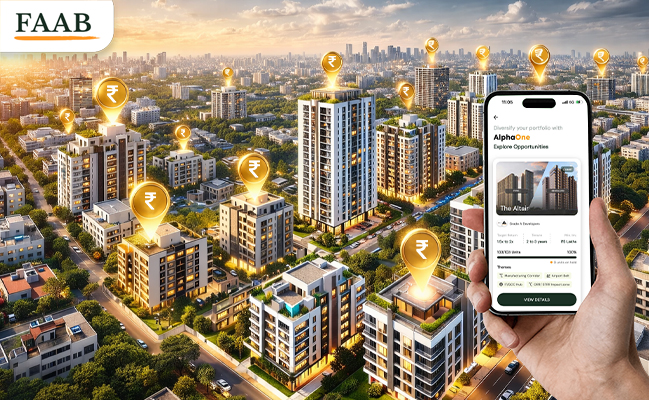
India’s real estate sector is entering a long-term expansion cycle driven by urbanization, infrastructure development, demographic strength, and regulatory reforms. Currently valued at approximately USD 0.3 trillion, the sector contributes around 6–8% to India’s GDP. Industry projections indicate that it could expand to USD 5–10 trillion by 2047, potentially accounting for 14–20% of GDP. This positions real estate as a central pillar in India’s broader ambition of becoming a developed economy by its centenary year of independence.
Within this transformation, residential real estate stands out as a structurally supported asset class.
At the same time, residential property prices across major cities continue to rise. In many prime markets, acquiring a quality residential unit outright requires ₹2–5 crore or more. As capital thresholds increase, investors are increasingly seeking structured and scalable ways to participate in the sector’s long-term growth without concentrated capital exposure.
This is where fractional ownership in residential real estate is gaining strategic relevance.
With entry starting from ₹5 lakhs, fractional ownership enables broader participation in high-value residential assets, focusing purely on capital appreciation
What Is Fractional Ownership in Residential Real Estate?
Fractional ownership allows multiple investors to collectively own a residential property by purchasing proportional shares.
The structure is simple and transparent:
- A carefully selected residential asset is identified
- Investors contribute capital starting from ₹5 lakhs
- Each investor holds a defined ownership percentage
- The asset is held through a defined investment horizon
- Returns are realized when the property appreciates and is sold
There is no rental income component in this model. The strategy is designed around long-term value growth through property price appreciation.
In essence:
Strategic entry → Hold through growth cycle → Exit at enhanced valuation
Rather than replacing traditional ownership, fractional models expand access by introducing a structured participation framework.
Structural Drivers Supporting Residential Growth
India’s residential market is supported by powerful macroeconomic and demographic trends.
Urbanization
India’s urban population is projected to reach 900 million by 2050, a significant increase from current levels. Urbanization has steadily risen over the past two decades and is expected to cross the 50% mark in the coming decades.
By 2047, nearly 100 cities may have populations exceeding one million. As employment clusters expand and income levels rise, sustained housing demand becomes a structural outcome rather than a cyclical event.
Urban expansion continues to drive residential absorption across both established and emerging markets.
Infrastructure Expansion
Infrastructure development plays a direct role in property value creation.
Long-term projections suggest:
- National highways exceeding 200,000 km
- High-speed rail network surpassing 7,000 km
- Airport count increasing toward 400
- Port handling capacity exceeding 10,000 MMT annually
Integrated infrastructure initiatives are unlocking new residential corridors and strengthening connectivity across regions.
Historically, improved infrastructure has been closely associated with sustained property appreciation over time.
Regulatory Formalization
The sector’s evolution has been reinforced by key policy reforms:
- RERA, enhancing transparency and accountability in residential projects
- GST implementation, simplifying taxation structures
- REIT regulations, institutionalizing real estate participation
- SM REIT frameworks, enabling structured and fractional participation
These measures have increased investor confidence and reduced opacity, strengthening real estate’s position as a structured asset class.
Residential Demand Outlook
Industry projections indicate:
- Annual residential sales could reach 1 million units by 2047
- Rising demand for premium housing, villas, plotted developments, and technology-enabled homes
Demographics further reinforce this outlook. India’s median age is steadily moving into the 30–40-year bracket, typically associated with peak earning capacity and homeownership decisions.
These structural drivers collectively support appreciation-focused investment strategies in residential real estate.
Market Participation and Growth Trends
Fractional real estate participation has expanded meaningfully in recent years.
In 2023, the size of the fractional ownership market was estimated at approximately USD 500 million. The segment is expected to grow nearly 10x, potentially surpassing USD 5 billion in assets under management (AUM) by 2030.
Lower entry thresholds have broadened participation beyond traditional high-net-worth investors to include:
- Young professionals
- First-time real estate investors
- NRIs
- Portfolio-focused investors
The ₹5 lakh entry point has played a critical role in widening structured access to real estate markets.
A Structural Shift in Access
Fractional ownership represents an evolution in how investors engage with residential real estate:
- Lower capital entry (₹5 lakhs)
- Access to premium residential assets
- Defined ownership structure
- Portfolio diversification potential
- Clear capital appreciation focus
Rather than concentrating capital in a single high-ticket property, investors can align allocation with broader portfolio strategies.
It complements traditional ownership by expanding participation opportunities without replacing conventional buying.
Final Perspective
India’s residential real estate market continues to be supported by strong structural fundamentals: urbanization, infrastructure expansion, demographic strength, regulatory formalization, and increasing institutional participation.
With the sector projected to expand from USD 0.3 trillion to potentially USD 5–10 trillion by 2047, structured participation models are becoming increasingly relevant.
Fractional ownership in residential real estate — starting from ₹5 lakhs — enables broader participation in this long-term growth trajectory, aligning accessibility with capital appreciation potential in India’s evolving property landscape.
As the sector matures and institutionalizes, participation frameworks are evolving in parallel — making structured access an integral part of India’s residential growth story.